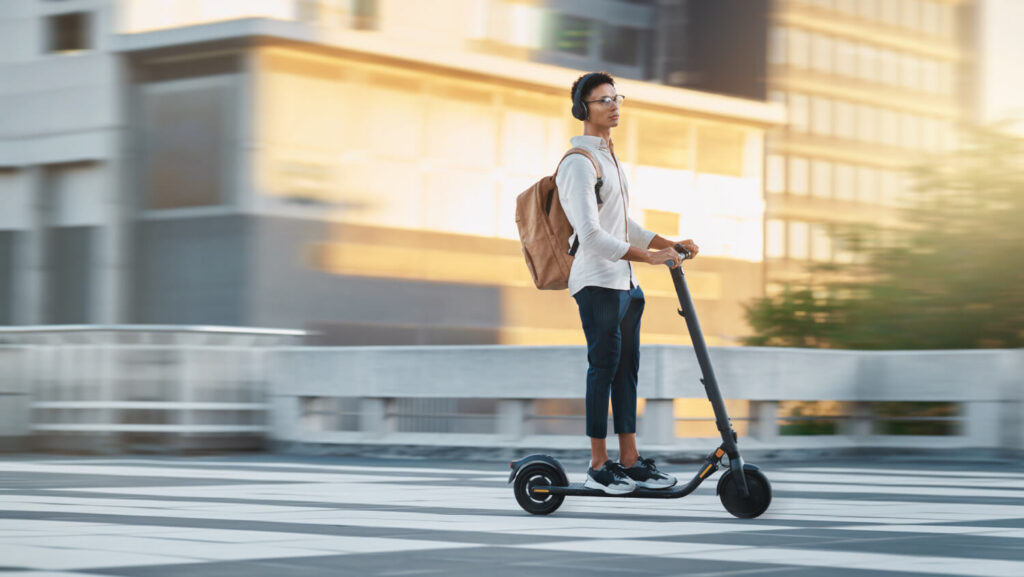
I have been a plaintiff’s product liability lawyer for over 40 years now, and I have been watching a dangerous trend emerging from the increased popularity of e-bikes and e-scooters. I’ve been riding e-bikes for eight years now, and I currently keep several in rotation. So, when I say I follow the lithium-ion battery fire issue closely, it’s not purely academic or professional— it’s the same battery chemistry sitting in my garage every night.
That dual vantage point, as both a rider and a lawyer, is exactly why this topic keeps pulling my attention: e-bikes and e-scooters have exploded in popularity across California, from delivery riders in San Francisco to commuters in Los Angeles, and that growth has been matched by a rise in fires and explosions tied to the batteries that power them. What follows is a fast-developing body of products liability exposure for manufacturers, importers, retailers, and even landlords. This post walks through how California product liability law applies to these cases and what practitioners — and honestly, fellow riders — should be watching.
Anyone who’s owned an e-bike for a while has absorbed the basic folk wisdom — don’t leave it charging overnight, don’t buy the cheap knockoff battery, unplug it before you leave for work. What that folk wisdom is actually describing is ‘thermal runaway ‘: an internal short circuit that generates heat, which triggers a chain reaction across neighboring cells, producing an intense, fast-spreading fire that is difficult if not impossible to extinguish with water or even a fire extinguisher. As both a rider and a lawyer, I’d stress that the legal problem tracks the physical one almost exactly — because the failure mode is chemical and often destroys the evidence.
These cases frequently turn into a battle of experts over cause and origin, which makes early evidence preservation critical. Practitioners handling these claims should get the device and battery into controlled storage immediately and arrange for a joint or independent forensic inspection before any component degrades further or is discarded by a landlord, fire department, or insurer. A recent e-cigarette case I handled was made far more difficult because, right after the main fire that started in my client’s pocket, my client’s co-workers stomped out the fire and disposed of the remains of the battery.
Aside from the danger that this fire would still spread and destroy the entire building, the defective battery went out with the trash, and we were unable to definitively identify the battery manufacturer. That fact alone doomed this particular case. Evidence preservation is the key.
California has applied strict products liability since the California Supreme Court’s decision in *Greenman v. Yuba Power Products* (1963), and the doctrine reaches every level of the distribution chain — manufacturer, component-part maker, importer, distributor, and retailer can all potentially be held strictly liable, regardless of fault, once a defect is proven to have caused injury or death.
Under ‘Barker v. Lull Engineering Co.’ (1978) 20 Cal.3d 413, California recognizes three categories of defect relevant to battery fire cases, reflected in the Judicial Council’s standard jury instructions:
-“Manufacturing defect (CACI 1201):” The specific battery or unit differed from the manufacturer’s intended design or from other units of the same design — for example, a cell with a manufacturing flaw that caused an internal short.
– “Design defect (CACI 1203/1204):” California uniquely allows plaintiffs to prove design defect under either of two independent tests — the “consumer expectation test” the product failed to perform as safely as an ordinary consumer would expect) or the “risk-benefit test” (the risks of the design outweigh its benefits, considering the feasibility of a safer alternative design). Because either test independently supports liability, California is considered relatively plaintiff-friendly compared to jurisdictions that only apply a risk-utility standard.
– “Failure to warn (CACI 1205):” The manufacturer or seller knew or should have known of the battery’s fire risk under foreseeable conditions of use (extreme heat, damage, prolonged charging) and failed to give an adequate warning.
Negligence and breach of warranty theories are typically pleaded alongside strict liability, since they can reach conduct-based issues — such as a retailer’s failure to inspect a shipment of counterfeit batteries — that a pure strict liability theory doesn’t directly address.
A few recurring issues tend to decide these cases:
California’s approach mirrors New York City’s Local Law 39, which mandated UL 2849/2271/2272 certification for e-mobility devices in 2023 and has been credited with a sharp subsequent drop in fire deaths there. San Francisco has also moved at the local level: following a December 2025 fire caused by a malfunctioning lithium-ion battery that displaced 130 residents of a Tenderloin apartment building, a city supervisor introduced an ordinance in April 2026 to prohibit the sale of uncertified batteries and mobility devices, with penalties of up to $1,000 per violation. Expect this kind of local and state regulatory activity to keep generating negligence per se arguments and informing what a jury considers “ordinary consumer expectations” for battery safety going forward.
None of this has made me stop riding — I still charge my own bikes every week, and I’m not looking to scare anyone off a genuinely good form of transportation. But eight years of doing this has made me a lot more deliberate about where I charge, what charger I use, and which certifications I actually check for before buying a replacement battery. That same instinct is a useful one to bring into these cases: the facts that matter to a jury (where was it charging, whose charger, was it certified) are the same facts that matter to a rider trying not to burn their garage down.
Selected Sources
– [SB 1271 overview — California e-bike battery certification requirements (Fox5 San Diego)](https://fox5sandiego.com/news/california-news/new-e-bike-safety-bill-takes-effect-in-california-in-2026/)
– [*Barker v. Lull Engineering Co.* (1978) 20 Cal.3d 413 — full opinion (Justia)](https://law.justia.com/cases/california/supreme-court/3d/20/413.html)
– [CACI 1203 — Strict Liability, Design Defect, Consumer Expectation Test (Justia)](https://www.justia.com/trials-litigation/docs/caci/1200/1203/)
– [San Francisco lithium-ion battery ordinance proposal following Tenderloin fire (SF Standard)](https://sfstandard.com/2026/04/07/sf-lithium-ion-battery-legislation-bilal-mahmood/)
—
*This article is for general informational purposes and does not constitute legal advice.*