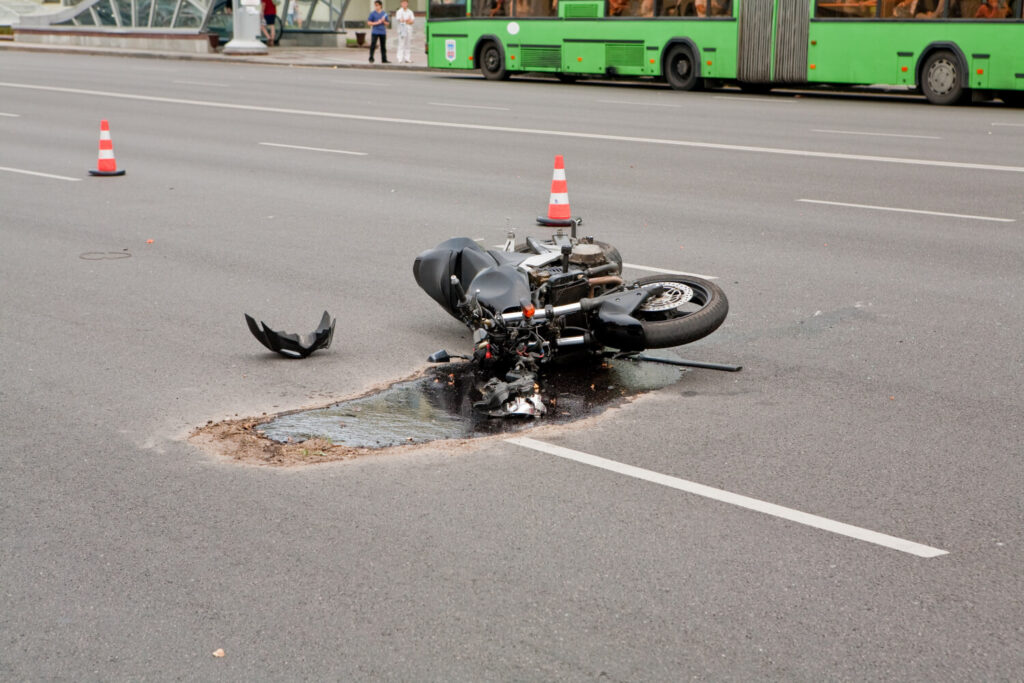
You might be replaying the moment over and over in your head. The scooter cut in front of you, the cyclist swerved into your lane, or a pedestrian stepped off the curb without looking, and you did what any careful rider would do. You laid the bike down or swerved to avoid a direct hit, and now you are the one injured, facing medical bills, bike repairs, and a lot of questions about who is actually responsible.
That is the harsh “before and after” of a motorcycle crash in San Francisco. One moment you are just riding, the next you are in pain, worried about work, money, and whether anyone will believe your side of the story. You may even be blaming yourself for doing the right thing and trying to avoid hitting someone.
Here is the short version. Fault in these situations is rarely simple. California law can hold a scooter rider, cyclist, or pedestrian responsible if they acted unsafely, even if you never physically hit them. At the same time, insurance companies often try to push blame onto the motorcyclist. You do not have to accept that. With the right evidence and legal guidance, you can often prove that someone else’s careless move set everything in motion.
When You Crash While Trying To Avoid Someone, Can They Still Be At Fault?
It feels unfair. You tried to spare someone else from serious harm, yet now you are the one hurting and being questioned. Because of this tension, you might wonder whether the law ever recognizes that the person you avoided caused your crash, even without a collision.
In California, the answer is yes. A person can be at fault if their unsafe behavior forced you into a dangerous maneuver that a reasonably careful rider would not otherwise have made. This is true whether that person was walking, riding a scooter, or cycling.
For example, California law expects drivers to yield to pedestrians in crosswalks. Still, it also requires pedestrians not to suddenly leave a curb or walk into the path of a vehicle that is too close to stop in time. You can see this balance in California Vehicle Code section 21950. The law protects people on foot, yet it also recognizes that they share responsibility for safety.
The same shared responsibility applies to cyclists and scooter riders. Everyone must follow the rules of the road, which are outlined in the California Driver Handbook. If someone weaves through traffic, runs a red light, or rides against traffic and you crash trying to avoid them, their choices may be a key factor in who is at fault.
Why These San Francisco Motorcycle Crashes Feel So Complicated
San Francisco is crowded, fast-moving, and full of mixed traffic. E-scooters are scattered near bike lanes, cyclists filter between cars, and pedestrians often cross mid-block or look at their phones instead of traffic. In this environment, a moment of carelessness can put a motorcyclist in an impossible position.
Consider a few common scenarios.
A scooter rider darts from between parked cars into your lane. You grab the brakes, the back tire locks up, and you go down. The scooter never touches you, then leaves the scene. Or a cyclist suddenly cuts across your lane to reach a bike lane. You swerve left to avoid them and end up colliding with a car. In another situation, a pedestrian steps out against the light in the Mission. You veer away to avoid hitting them and slide across the intersection.
In every one of these examples, you may feel both lucky and guilty. Lucky that you did not hit the other person. Guilty because you crashed and maybe involved other vehicles. Yet from a legal standpoint, the core question is the same. Did someone else’s unsafe move create a situation that a reasonably careful rider could not safely avoid?
Insurance adjusters rarely rush to see it that way. They often assume the motorcyclist was speeding, not paying attention, or “accepting the risk” by riding in the first place. That can leave you feeling dismissed and powerless.
This is where a thoughtful, experienced San Francisco motorcycle accident lawyer can change the story. With investigation, witness statements, street camera footage, and sometimes expert analysis of the crash dynamics, it is often possible to show that a scooter rider, cyclist, or pedestrian set off the chain of events.
How Does Fault Work When Everyone Shares the Road?
California uses what is called comparative negligence. That means fault can be shared. You might be found 20 percent responsible and the pedestrian 80 percent. Or the cyclist might be mostly at fault, with a smaller share assigned to you or even another driver.
Even if you are found partly responsible, you can still recover money for your injuries. Your compensation is just reduced by your percentage of fault. This is important in “avoidance crash” cases, where everyone’s behavior is examined closely.
To understand how responsibility is supposed to work among different road users, it can be helpful to look at safety guidance and crash data. The California Department of Transportation has a technical reference on pedestrian and bicycle safety, including risk factors and design issues, which you can see in this Caltrans pedestrian and bicycle safety guide. It shows how often conflicts arise at intersections, driveways, and mid-block crossings. Those same conflict points are where many motorcyclists get forced into sudden, dangerous choices.
So where does that leave you after a crash like this in San Francisco? It leaves you needing to protect yourself early, gather evidence, and have someone on your side who understands how these shared-road cases work.
Comparing Your Options After a Motorcycle Crash While Avoiding Someone
When you are hurt, and your bike is damaged, it is tempting to just answer the insurance calls and hope for the best. It can help to compare that approach with getting help from an experienced attorney.
| Approach | What It Looks Like | Possible Risks | Possible Benefits |
| Handling the claim on your own | You speak directly with adjusters, give statements, gather your own photos and records, and try to negotiate a settlement yourself. | Insurance may blame you entirely. Important evidence about the scooter, cyclist, or pedestrian may be lost. You may accept a low offer because you are tired or unsure what your case is worth. | Faster decisions in simple cases. No attorney fee. Works better if injuries are very minor and fault is clear. |
| Waiting and doing nothing | You focus only on healing and work. You do not report all symptoms, you do not collect evidence, and you hope things “work out.” | Deadlines can pass. Witnesses disappear. Video is erased. Your injuries might be questioned later because there is no clear record. | Less stress in the short term. No immediate conflict with insurance companies. |
| Working with a motorcycle accident lawyer | A lawyer investigates how the scooter, cyclist, or pedestrian behaved, gathers evidence, deals with insurance, and builds a legal claim while you focus on recovery. | Takes time to investigate. You share a portion of the recovery as a fee if the case is successful. | Stronger chance of proving fault. Better documentation of injuries and losses. Someone else handles the stress and strategy. |
For many riders, especially in complex “no contact” or avoidance crashes, getting legal help is the only way their side of the story is fully heard.
Three Immediate Steps To Protect Yourself After An Avoidance Crash
- Get medical care and tell the full story of how you crashed
Even if you walked away from the scene, see a doctor as soon as you can. Some injuries show up hours or days later. When you explain what happened, include that you crashed while avoiding a scooter, cyclist, or pedestrian. This links your injuries to the event and becomes part of the record.
- Preserve every possible piece of evidence
Take photos of your motorcycle, your gear, the roadway, skid marks, debris, and nearby traffic signals or signs. Write down everything you remember about the scooter, cyclist, or pedestrian, including direction of travel, clothing, or any identifying details. If there were witnesses, get their names and contact information. In San Francisco, many intersections and storefronts have cameras. Acting quickly can help your lawyer track down footage before it is erased.
- Speak with a San Francisco motorcycle accident lawyer before giving detailed statements
Insurance adjusters may sound friendly, but their job is to limit what they pay. In an avoidance crash, offhand comments like “I just laid the bike down” or “I did not hit anyone” can be twisted to suggest you were the sole cause. A seasoned attorney can guide you on what to say, how to say it, and when to say nothing at all. This is especially important in a motorcycle accident claim involving a pedestrian or cyclist, where fault can be highly contested.
Moving Forward With Support You Can Trust
You did what your instincts told you to do. You tried to protect another human being, even at a cost to yourself. Now you deserve the same care and protection as you work through the aftermath of the crash.
You do not have to sort out fault, medical bills, and insurance pressure on your own. The San Francisco personal injury attorneys at Choulos, Choulos & Wyle understand how these shared-road crashes happen and how unfair the system can feel to riders. Their work as motorcycle accident lawyer advocates is focused on standing up for people exactly like you.
Our San Francisco personal injury attorneys have been representing victims in a variety of types of cases for decades. The team at Choulos, Choulos & Wyle Personal Injury Lawyers is ready to help. If you or a loved one is a victim, you can turn to our law firm with confidence. To talk about what happened and what your options are, you can call (415) 432-7290.